


The Horse Science & Innovation Lab
Goals
Our team studies horse movement, physiology, and behavior using a mix of mathematics, engineering, and equine science. We analyze how gait, breathing, and heart rate are linked in both horses and riders, with applications in training, performance, and welfare. Using high-speed video, motion tracking, and computational modeling, we assess movement asymmetries that can reveal injury patterns or training imbalances. We also apply computational fluid dynamics to study blood flow and turbulence in the equine cardiovascular system, helping us understand risks like sudden cardiac death.
Beyond biomechanics, we investigate equine behavior and welfare, using data-driven methods to study horse personality, learning, and stress responses. Our goal is to support evidence-based training and management practices that improve horse well-being in sport, rehabilitation, and daily care. Students on our team gain hands-on research experience, working with real data from horses. This team is a good fit for students in mathematics, engineering, veterinary science, animal behavior, and biomechanics who want to apply their skills to real-world problems. Learn more about the broader interests of the Miller Lab.
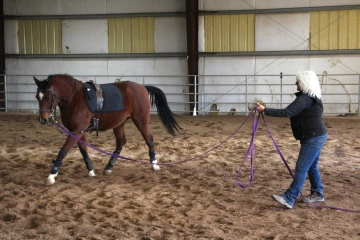

As some of you may know, the University of Arizona is in the process of selling the Al Marah Equine Center (pictured above). Because of this, we are revamping the VIP and related student opportunities for students who want to stay involved in horse-centered STEM, outreach, biomechanics, education, and data analysis. In Fall 2026, we plan to collaborate with Mighty Minds, an educational program that works with K–12 students and animals/horses. There are three possible pathways (below).
The current possible schedule is:
- Tuesday Mighty Minds Farm School: 9:00 AM to 12:00 PM
- Wednesday Mighty Minds Learning Pods: 9:00 AM to 1:00 PM
- Thursday Mighty Minds Farm School: 9:00 AM to 12:00 PM
- Flexible/remote or UA-based times: data analysis, behavior coding, lesson/activity design, and research support
Learning Pods / STEM Education
- Help develop and support animal- and horse-centered STEM activities for K–12 students at Mighty Minds.
- Many of the kids are 10 or under, so this work is more about education, creativity, communication, and age-appropriate quantitative thinking than advanced STEM material.
- Possible activities: feed measurement, budgeting/costs of horse care, analog/military time, stride length, distance, motion, symmetry/asymmetry, and observation of animal behavior.
- Involves in-person work with K–12 students at an off-campus site, so students will likely need to be enrolled for internship credit or another approved university structure before participating. Students may also need to complete a background check.
Horsemanship Support
- Depending on the student’s horse experience, comfort level, and the needs of Mighty Minds, students may help support horsemanship activities.
- Possible Activities: helping students learn safe behavior around horses, observing horse body language, supporting grooming or groundwork activities, helping with set-up and clean-up, assisting with horse-centered lessons, and helping students connect horse care and horsemanship to STEM concepts such as measurement, timing, motion, balance, and animal behavior.
- Students would not be expected to teach independently or take on responsibilities beyond their training. Safety, supervision, and appropriate boundaries will be central.
- Involves in-person work with K–12 students at an off-campus site, so students will likely need to be enrolled for internship credit or another approved university structure before participating. Students may also need to complete a background check.
Data Analysis / Research Support
- Students who are more interested in the research side (or not able to travel off-campus) may work on data analysis, behavior coding, biomechanics, time-series analysis, activity design, or related projects as part of the VIP team.
- Some advanced students may work on more mathematical or computational projects involving coding, calculus, simple ODEs, gait, motion, respiration, or heart-rate dynamics.
- This option does not include any direct interaction with horses, but the work is flexible in terms of hours and location.
Issues Involved or Addressed
- Gait, breathing, and heart rate coupling – How movement and physiology synchronize in horses and riders.
- Movement asymmetries – Identifying imbalances in gait linked to injury, training, or biomechanics.
- Computational modeling – Using math and engineering to analyze equine motion and physiology.
- Fluid dynamics of circulation – Studying blood flow and turbulence to understand sudden cardiac death in horses.
- High-speed video and motion tracking – Measuring movement patterns and detecting asymmetries.
- Equine behavior and personality – Using data-driven methods to study learning, stress, and welfare.
- Evidence-based training and management – Applying research to improve horse care and performance.
- Hands-on research with live horses – Collecting and analyzing real-world data at Al Marah Equine Center.
- STEM applications in equine science – Bridging mathematics, engineering, and animal science.


Methods and Tech
- High-speed video analysis – Capturing and quantifying horse and rider movement.
- Motion tracking and inertial measurement – Measuring stride patterns, asymmetries, and coordination.
- Computational fluid dynamics (CFD) – Simulating blood flow and turbulence in the equine cardiovascular system.
- Mathematical modeling – Developing equations and simulations to describe gait mechanics and physiology.
- Data science and signal processing – Analyzing heart rate, respiration, and movement data.
- Wearable sensors – Monitoring physiological responses in horses and riders.
- Equine behavior analysis – Applying quantitative methods to study learning, stress, and personality.
- Engineering design – Developing tools and systems for equine biomechanics research.
Academic Majors of Interest
We are open to students from all disciplines but especially seek participants from:
- Agricultural and Biosystems Engineering
- Animal and Veterinary Sciences
- Biomedical Engineering
- Computer Science
- Electrical and Computer Engineering
- Mathematics
- Mechanical Engineering
- Physiology and Medical Sciences
- Psychology
Preferred Interests and Preparation
Students are not expected to have all of these skills—rather, a subset that aligns with their major and interests is sufficient. Our team is interdisciplinary, and each student brings a unique perspective, whether in mathematics, engineering, computer science, animal science, or physiology. We encourage applicants who are eager to learn, collaborate, and apply their expertise to equine biomechanics, physiology, and behavior. Training will be provided as needed, so students should be motivated to develop new skills and contribute to the team.
Skills:
- Data analysis and statistical reasoning
- Computational modeling and simulation
- Engineering design and problem-solving
- Motion tracking and biomechanics analysis
- Experience with programming (e.g., Python, MATLAB, R)
- Familiarity with wearable sensors and physiological monitoring
- Laboratory or field research experience
- Knowledge of equine science, behavior, or veterinary principles
Attributes:
- Curious and eager to apply STEM to real-world problems
- Detail-oriented and analytical thinker
- Willing to work with live animals in a research setting
- Comfortable collaborating across disciplines
- Self-motivated and able to work independently
- Strong communication and teamwork skills
- Open to learning new methods and technologies
Application Process
Participation in this VIP is unpaid. We are exploring internship-credit options through Math, ACBS, or other appropriate departments, depending on the student’s level, major, and role.
To express interest in this team, please complete this Google Form so the team can understand your availability, background, interests, and whether you are seeking credit.
This team:
- Accepts new students at the start of each semester.
- Involves student researchers for course credit.